AWS Certified Developer Associate DVA-C01 – Question236

Two containerized microservices are hosted on Amazon EC2 ECS. The first microservice reads an Amazon RDS Aurora database instance, and the second microservice reads an Amazon DynamoDB table.
How can each microservice be granted the minimum privileges?

A.
Set ECS_ENABLE_TASK_IAM_ROLE to false on EC2 instance boot in ECS agent configuration file. Run the first microservice with an IAM role for ECS tasks with read-only access for the Aurora database. Run the second microservice with an IAM role for ECS tasks with read-only access to DynamoDB.
B. Set ECS_ENABLE_TASK_IAM_ROLE to false on EC2 instance boot in the ECS agent configuration file. Grant the instance profile role read-only access to the Aurora database and DynamoDB.
C. Set ECS_ENABLE_TASK_IAM_ROLE to true on EC2 instance boot in the ECS agent configuration file. Run the first microservice with an IAM role for ECS tasks with read-only access for the Aurora database. Run the second microservice with an IAM role for ECS tasks with read-only access to DynamoDB.
D. Set ECS_ENABLE_TASK_IAM_ROLE to true on EC2 instance boot in the ECS agent configuration file. Grant the instance profile role read-only access to the Aurora database and DynamoDB.

Correct Answer: C

AWS Certified Developer Associate DVA-C01 – Question235

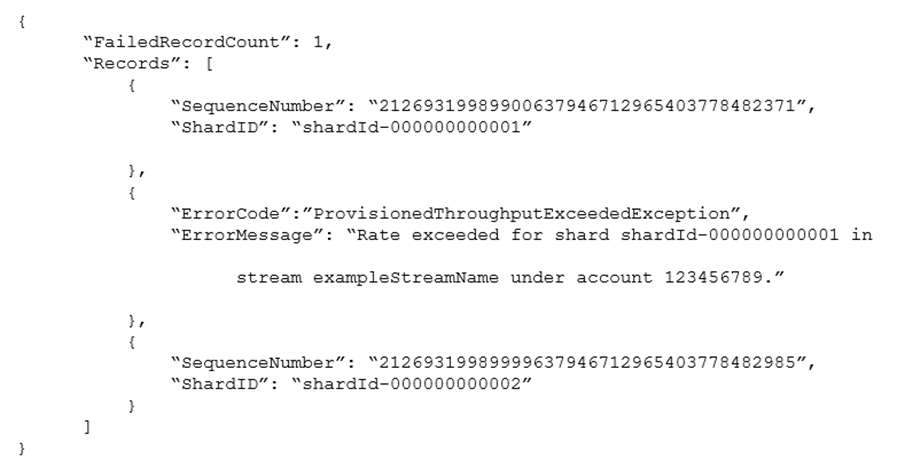
An application is processing clickstream data using Amazon Kinesis. The clickstream data feed into Kinesis experiences periodic spikes. The PutRecords API call occasionally fails and the logs show that the failed call returns the response shown below:

Which techniques will help mitigate this exception? (Choose two.)

A.
Implement retries with exponential backoff.
B. Use a PutRecord API instead of PutRecords.
C. Reduce the frequency and/or size of the requests.
D. Use Amazon SNS instead of Kinesis.
E. Reduce the number of KCL consumers.

Correct Answer: BD

AWS Certified Developer Associate DVA-C01 – Question234

A developer is troubleshooting a new AWS Lambda function. The function should run automatically each time a new object is uploaded to an Amazon S3 bucket. The function is supposed to read the object, make modifications, and overwrite the object with the new version. The developer finds that all calls failed within the function code.
Which of the following are possible reasons for this failure? (Choose two.)

A.
The function resource policy does not allow access from Amazon S3.
B. The function execution role does not allow access from Amazon S3.
C. The function execution role does not allow access to Amazon S3.
D. The S3 bucket policy does not allow access from the Lambda function.
E. The S3 bucket policy does not allow access to the Lambda function.

Correct Answer: AE

AWS Certified Developer Associate DVA-C01 – Question233

A developer is writing a web application that allows users to sign in. The application will run on Amazon EC2 instances behind an Application Load Balancer (ALB). The instances will run in an Auto Scaling group across multiple Availability Zones.
How can the developer ensure that users stay signed in when the Auto Scaling group is scaled down?

A.
Enable sticky sessions on the ALB target group.
B. Create an Amazon DynamoDB table. Configure the application to use the DynamoDB table to store session state such as login status.
C. Create an Amazon Elastic Block Store (Amazon EBS) volume. Use EBS Multi-Attach to attach the volume to all instances in the Auto Scaling group. Configure the application to use the volume to store session state such as login status.
D. Enable deregistration delay on the ALB target group.

Correct Answer: C

AWS Certified Developer Associate DVA-C01 – Question231

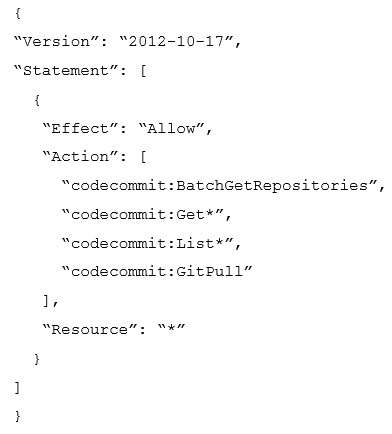
A Developer accesses AWS CodeCommit over SSH. The SSH keys configured to access AWS CodeCommit are tied to a user with the following permissions:

The Developer needs to create/delete branches.
Which specific IAM permissions need to be added, based on the principle of least privilege?

A.
"codecommit:CreateBranch" "codecommit:DeleteBranch"
B. "codecommit:Put*"
C. "codecommit:Update*"
D. "codecommit:*"

Correct Answer: C

AWS Certified Developer Associate DVA-C01 – Question230

A company has an application that generates large binary data outside of AWS. The company must encrypt the data before uploading the data to an Amazon S3 bucket.
Which solution will meet this requirement?

A.
Use the AWS Key Management Service (AWS KMS) encrypt command in the AWS CLI.
B. Configure server-side encryption on the S3 bucket.
C. Use the AWS Encryption SDK to perform client-side encryption of the data.
D. Specify the x-amz-server-side-encryption header when uploading the data to the S3 bucket.

Correct Answer: C

AWS Certified Developer Associate DVA-C01 – Question229

A developer at a company needs to create a small application that makes the same API call once each day at a designated time. The company does not have infrastructure in the AWS Cloud yet, but the company wants to implement this functionality on AWS.
Which solution meets these requirements in the MOST operationally efficient manner?

A.
Use a Kubernetes cron job that runs on Amazon Elastic Kubernetes Service (Amazon EKS).
B. Use an Amazon Linux crontab scheduled job that runs on Amazon EC2.
C. Use an AWS Lambda function that is invoked by an Amazon EventBridge (Amazon CloudWatch Events) scheduled event.
D. Use an AWS Batch job that is submitted to an AWS Batch job queue.

Correct Answer: C

AWS Certified Developer Associate DVA-C01 – Question228

A company has deployed an application on AWS Elastic Beanstalk. The company has configured the Auto Scaling group that is associated with the Elastic Beanstalk environment to have five Amazon EC2 instances. If the capacity is fewer than four EC2 instances during the deployment, application performance degrades. The company is using the all-at-once deployment policy.
What is the MOST cost-effective way to solve the deployment issue?

A.
Change the Auto Scaling group to six desired instances.
B. Change the deployment policy to traffic splitting. Specify an evaluation time of 1 hour.
C. Change the deployment policy to rolling with additional batch. Specify a batch size of 1.
D. Change the deployment policy to rolling. Specify a batch size of 2.

Correct Answer: D

AWS Certified Developer Associate DVA-C01 – Question227

A company has a multi-node Windows legacy application that runs on premises. The application uses a network shared folder as a centralized configuration repository to store configuration files in .xml format. The company is migrating the application to Amazon EC2 instances. As part of the migration to AWS, a developer must identify a solution that provides high availability for the repository.
Which solution will meet this requirement MOST cost-effectively?

A.
Mount an Amazon Elastic Block Store (Amazon EBS) volume onto one of the EC2 instances. Deploy a file system on the EBS volume. Use the host operating system to share a folder. Update the application code to read and write configuration files from the shared folder.
B. Deploy a micro EC2 instance with an instance store volume. Use the host operating system to share a folder. Update the application code to read and write configuration files from the shared folder.
C. Create an Amazon S3 bucket to host the repository. Migrate the existing .xml files to the S3 bucket. Update the application code to use the AWS SDK to read and write configuration files from Amazon S3.
D. Create an Amazon S3 bucket to host the repository. Migrate the existing xml files to the S3 bucket. Mount the S3 bucket to the EC2 instances as a local volume. Update the application code to read and write configuration files from the disk.

Correct Answer: C