AWS Certified Machine Learning – Specialty MLS-C01 – Question168

A data engineer at a bank is evaluating a new tabular dataset that includes customer data. The data engineer will use the customer data to create a new model to predict customer behavior. After creating a correlation matrix for the variables, the data engineer notices that many of the 100 features are highly correlated with each other.
Which steps should the data engineer take to address this issue? (Choose two.)

A.
Use a linear-based algorithm to train the model.
B. Apply principal component analysis (PCA).
C. Remove a portion of highly correlated features from the dataset.
D. Apply min-max feature scaling to the dataset.
E. Apply one-hot encoding category-based variables.
AWS Certified Machine Learning – Specialty MLS-C01 – Question167

A company has video feeds and images of a subway train station. The company wants to create a deep learning model that will alert the station manager if any passenger crosses the yellow safety line when there is no train in the station. The alert will be based on the video feeds. The company wants the model to detect the yellow line, the passengers who cross the yellow line, and the trains in the video feeds. This task requires labeling. The video data must remain confidential.
A data scientist creates a bounding box to label the sample data and uses an object detection model. However, the object detection model cannot clearly demarcate the yellow line, the passengers who cross the yellow line, and the trains.
Which labeling approach will help the company improve this model?

A.
Use Amazon Rekognition Custom Labels to label the dataset and create a custom Amazon Rekognition object detection model. Create a private workforce. Use Amazon Augmented AI (Amazon A2I) to review the low-confidence predictions and retrain the custom Amazon Rekognition model.
B. Use an Amazon SageMaker Ground Truth object detection labeling task. Use Amazon Mechanical Turk as the labeling workforce.
C. Use Amazon Rekognition Custom Labels to label the dataset and create a custom Amazon Rekognition object detection model. Create a workforce with a third-party AWS Marketplace vendor. Use Amazon Augmented AI (Amazon A2I) to review the low-confidence predictions and retrain the custom Amazon Rekognition model.
D. Use an Amazon SageMaker Ground Truth semantic segmentation labeling task. Use a private workforce as the labeling workforce.

AWS Certified Machine Learning – Specialty MLS-C01 – Question166

A company wants to create a data repository in the AWS Cloud for machine learning (ML) projects. The company wants to use AWS to perform complete ML lifecycles and wants to use Amazon S3 for the data storage. All of the company's data currently resides on premises and is 40 in size.
The company wants a solution that can transfer and automatically update data between the on-premises object storage and Amazon S3. The solution must support encryption, scheduling, monitoring, and data integrity validation.
Which solution meets these requirements?

A.
Use the S3 sync command to compare the source S3 bucket and the destination S3 bucket. Determine which source files do not exist in the destination S3 bucket and which source files were modified.
B. Use AWS Transfer for FTPS to transfer the files from the on-premises storage to Amazon S3.
C. Use AWS DataSync to make an initial copy of the entire dataset. Schedule subsequent incremental transfers of changing data until the final cutover from on premises to AWS.
D. Use S3 Batch Operations to pull data periodically from the on-premises storage. Enable S3 Versioning on the S3 bucket to protect against accidental overwrites.

Correct Answer: C

Explanation:

Explanation:
Configure DataSync to make an initial copy of your entire dataset, and schedule subsequent incremental transfers of changing data until the final cut-over from on-premises to AWS.
Reference: https://aws.amazon.com/datasync/faqs/

AWS Certified Machine Learning – Specialty MLS-C01 – Question165

A data scientist is using the Amazon SageMaker Neural Topic Model (NTM) algorithm to build a model that recommends tags from blog posts. The raw blog post data is stored in an Amazon S3 bucket in JSON format.
During model evaluation, the data scientist discovered that the model recommends certain stopwords such as "a," "an," and "the" as tags to certain blog posts, along with a few rare words that are present only in certain blog entries. After a few iterations of tag review with the content team, the data scientist notices that the rare words are unusual but feasible. The data scientist also must ensure that the tag recommendations of the generated model do not include the stopwords.
What should the data scientist do to meet these requirements?

A.
Use the Amazon Comprehend entity recognition API operations. Remove the detected words from the blog post data. Replace the blog post data source in the S3 bucket.
B. Run the SageMaker built-in principal component analysis (PCA) algorithm with the blog post data from the S3 bucket as the data source. Replace the blog post data in the S3 bucket with the results of the training job.
C. Use the SageMaker built-in Object Detection algorithm instead of the NTM algorithm for the training job to process the blog post data.
D. Remove the stopwords from the blog post data by using the CountVectorizer function in the scikit-learn library. Replace the blog post data in the S3 bucket with the results of the vectorizer.

AWS Certified Machine Learning – Specialty MLS-C01 – Question164

A data scientist is working on a public sector project for an urban traffic system. While studying the traffic patterns, it is clear to the data scientist that the traffic behavior at each light is correlated, subject to a small stochastic error term. The data scientist must model the traffic behavior to analyze the traffic patterns and reduce congestion.
How will the data scientist MOST effectively model the problem?

A.
The data scientist should obtain a correlated equilibrium policy by formulating this problem as a multi-agent reinforcement learning problem.
B. The data scientist should obtain the optimal equilibrium policy by formulating this problem as a single-agent reinforcement learning problem.
C. Rather than finding an equilibrium policy, the data scientist should obtain accurate predictors of traffic flow by using historical data through a supervised learning approach.
D. Rather than finding an equilibrium policy, the data scientist should obtain accurate predictors of traffic flow by using unlabeled simulated data representing the new traffic patterns in the city and applying an unsupervised learning approach.

Correct Answer: D

Explanation:

AWS Certified Machine Learning – Specialty MLS-C01 – Question163

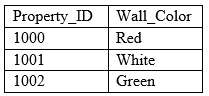
A machine learning specialist is developing a regression model to predict rental rates from rental listings. A variable named Wall_Color represents the most prominent exterior wall color of the property. The following is the sample data, excluding all other variables:

The specialist chose a model that needs numerical input data.
Which feature engineering approaches should the specialist use to allow the regression model to learn from the Wall_Color data? (Choose two.)

A.
Apply integer transformation and set Red = 1, White = 5, and Green = 10.
B. Add new columns that store one-hot representation of colors.
C. Replace the color name string by its length.
D. Create three columns to encode the color in RGB format.
E. Replace each color name by its training set frequency.

Correct Answer: AD

AWS Certified Machine Learning – Specialty MLS-C01 – Question162

A company is building a demand forecasting model based on machine learning (ML). In the development stage, an ML specialist uses an Amazon SageMaker notebook to perform feature engineering during work hours that consumes low amounts of CPU and memory resources. A data engineer uses the same notebook to perform data preprocessing once a day on average that requires very high memory and completes in only 2 hours. The data preprocessing is not configured to use GPU. All the processes are running well on an ml.m5.4xlarge notebook instance.
The company receives an AWS Budgets alert that the billing for this month exceeds the allocated budget.
Which solution will result in the MOST cost savings?

A.
Change the notebook instance type to a memory optimized instance with the same vCPU number as the ml.m5.4xlarge instance has. Stop the notebook when it is not in use. Run both data preprocessing and feature engineering development on that instance.
B. Keep the notebook instance type and size the same. Stop the notebook when it is not in use. Run data preprocessing on a P3 instance type with the same memory as the ml.m5.4xlarge instance by using Amazon SageMaker Processing.
C. Change the notebook instance type to a smaller general purpose instance. Stop the notebook when it is not in use. Run data preprocessing on an ml.r5 instance with the same memory size as the ml.m5.4xlarge instance by using Amazon SageMaker Processing.
D. Change the notebook instance type to a smaller general purpose instance. Stop the notebook when it is not in use. Run data preprocessing on an R5 instance with the same memory size as the ml.m5.4xlarge instance by using the Reserved Instance option.

Correct Answer: B

AWS Certified Machine Learning – Specialty MLS-C01 – Question161

A company wants to use automatic speech recognition (ASR) to transcribe messages that are less than 60 seconds long from a voicemail-style application. The company requires the correct identification of 200 unique product names, some of which have unique spellings or pronunciations.
The company has 4,000 words of Amazon SageMaker Ground Truth voicemail transcripts it can use to customize the chosen ASR model. The company needs to ensure that everyone can update their customizations multiple times each hour.
Which approach will maximize transcription accuracy during the development phase?

A.
Use a voice-driven Amazon Lex bot to perform the ASR customization. Create customer slots within the bot that specifically identify each of the required product names. Use the Amazon Lex synonym mechanism to provide additional variations of each product name as mis-transcriptions are identified in development.
B. Use Amazon Transcribe to perform the ASR customization. Analyze the word confidence scores in the transcript, and automatically create or update a custom vocabulary file with any word that has a confidence score below an acceptable threshold value. Use this updated custom vocabulary file in all future transcription tasks.
C. Create a custom vocabulary file containing each product name with phonetic pronunciations, and use it with Amazon Transcribe to perform the ASR customization. Analyze the transcripts and manually update the custom vocabulary file to include updated or additional entries for those names that are not being correctly identified.
D. Use the audio transcripts to create a training dataset and build an Amazon Transcribe custom language model. Analyze the transcripts and update the training dataset with a manually corrected version of transcripts where product names are not being transcribed correctly. Create an updated custom language model.

Correct Answer: A

Explanation:

AWS Certified Machine Learning – Specialty MLS-C01 – Question160

A power company wants to forecast future energy consumption for its customers in residential properties and commercial business properties. Historical power consumption data for the last 10 years is available. A team of data scientists who performed the initial data analysis and feature selection will include the historical power consumption data and data such as weather, number of individuals on the property, and public holidays.
The data scientists are using Amazon Forecast to generate the forecasts.
Which algorithm in Forecast should the data scientists use to meet these requirements?

A.
Autoregressive Integrated Moving Average (AIRMA)
B. Exponential Smoothing (ETS)
C. Convolutional Neural Network – Quantile Regression (CNN-QR)
D. Prophet

Correct Answer: B

Explanation:

AWS Certified Machine Learning – Specialty MLS-C01 – Question159

A company that manufactures mobile devices wants to determine and calibrate the appropriate sales price for its devices. The company is collecting the relevant data and is determining data features that it can use to train machine learning (ML) models. There are more than 1,000 features, and the company wants to determine the primary features that contribute to the sales price.
Which techniques should the company use for feature selection? (Choose three.)

A.
Data scaling with standardization and normalization
B. Correlation plot with heat maps
C. Data binning
D. Univariate selection
E. Feature importance with a tree-based classifier
F. Data augmentation