AWS Certified Machine Learning – Specialty MLS-C01 – Question158

A data scientist is training a text classification model by using the Amazon SageMaker built-in BlazingText algorithm. There are 5 classes in the dataset, with 300 samples for category A, 292 samples for category B, 240 samples for category C, 258 samples for category D, and 310 samples for category E.
The data scientist shuffles the data and splits off 10% for testing. After training the model, the data scientist generates confusion matrices for the training and test sets.
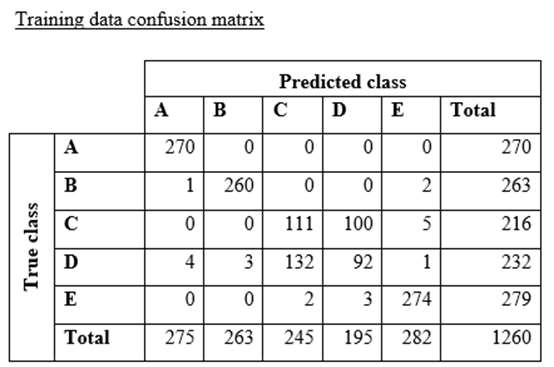
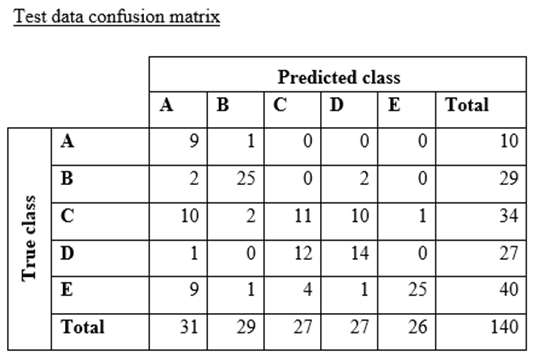
What could the data scientist conclude form these results?

A.
Classes C and D are too similar.
B. The dataset is too small for holdout cross-validation.
C. The data distribution is skewed.
D. The model is overfitting for classes B and E.

Correct Answer: B

AWS Certified Machine Learning – Specialty MLS-C01 – Question157

An ecommerce company is automating the categorization of its products based on images. A data scientist has trained a computer vision model using the Amazon SageMaker image classification algorithm. The images for each product are classified according to specific product lines. The accuracy of the model is too low when categorizing new products. All of the product images have the same dimensions and are stored within an Amazon S3 bucket. The company wants to improve the model so it can be used for new products as soon as possible.
Which steps would improve the accuracy of the solution? (Choose three.)

A.
Use the SageMaker semantic segmentation algorithm to train a new model to achieve improved accuracy.
B. Use the Amazon Rekognition DetectLabels API to classify the products in the dataset.
C. Augment the images in the dataset. Use open source libraries to crop, resize, flip, rotate, and adjust the brightness and contrast of the images.
D. Use a SageMaker notebook to implement the normalization of pixels and scaling of the images. Store the new dataset in Amazon S3.
E. Use Amazon Rekognition Custom Labels to train a new model.
F. Check whether there are class imbalances in the product categories, and apply oversampling or undersampling as required. Store the new dataset in Amazon S3.

AWS Certified Machine Learning – Specialty MLS-C01 – Question156

A company supplies wholesale clothing to thousands of retail stores. A data scientist must create a model that predicts the daily sales volume for each item for each store. The data scientist discovers that more than half of the stores have been in business for less than 6 months. Sales data is highly consistent from week to week.
Daily data from the database has been aggregated weekly, and weeks with no sales are omitted from the current dataset. Five years (100 MB) of sales data is available in Amazon S3.
Which factors will adversely impact the performance of the forecast model to be developed, and which actions should the data scientist take to mitigate them? (Choose two.)

A.
Detecting seasonality for the majority of stores will be an issue. Request categorical data to relate new stores with similar stores that have more historical data.
B. The sales data does not have enough variance. Request external sales data from other industries to improve the model's ability to generalize.
C. Sales data is aggregated by week. Request daily sales data from the source database to enable building a daily model.
D. The sales data is missing zero entries for item sales. Request that item sales data from the source database include zero entries to enable building the model.
E. Only 100 MB of sales data is available in Amazon S3. Request 10 years of sales data, which would provide 200 MB of training data for the model.

AWS Certified Machine Learning – Specialty MLS-C01 – Question155

A machine learning (ML) specialist is administering a production Amazon SageMaker endpoint with model monitoring configured. Amazon SageMaker Model Monitor detects violations on the SageMaker endpoint, so the ML specialist retrains the model with the latest dataset. This dataset is statistically representative of the current production traffic. The ML specialist notices that even after deploying the new SageMaker model and running the first monitoring job, the SageMaker endpoint still has violations.
What should the ML specialist do to resolve the violations?

A.
Manually trigger the monitoring job to re-evaluate the SageMaker endpoint traffic sample.
B. Run the Model Monitor baseline job again on the new training set. Configure Model Monitor to use the new baseline.
C. Delete the endpoint and recreate it with the original configuration.
D. Retrain the model again by using a combination of the original training set and the new training set.

Correct Answer: B

AWS Certified Machine Learning – Specialty MLS-C01 – Question154

A machine learning specialist needs to analyze comments on a news website with users across the globe. The specialist must find the most discussed topics in the comments that are in either English or Spanish.
What steps could be used to accomplish this task? (Choose two.)

A.
Use an Amazon SageMaker BlazingText algorithm to find the topics independently from language. Proceed with the analysis.
B. Use an Amazon SageMaker seq2seq algorithm to translate from Spanish to English, if necessary. Use a SageMaker Latent Dirichlet Allocation (LDA) algorithm to find the topics.
C. Use Amazon Translate to translate from Spanish to English, if necessary. Use Amazon Comprehend topic modeling to find the topics.
D. Use Amazon Translate to translate from Spanish to English, if necessary. Use Amazon Lex to extract topics form the content.
E. Use Amazon Translate to translate from Spanish to English, if necessary. Use Amazon SageMaker Neural Topic Model (NTM) to find the topics.

Correct Answer: B

Explanation:

AWS Certified Machine Learning – Specialty MLS-C01 – Question153

A manufacturing company asks its machine learning specialist to develop a model that classifies defective parts into one of eight defect types. The company has provided roughly 100,000 images per defect type for training.
During the initial training of the image classification model, the specialist notices that the validation accuracy is 80%, while the training accuracy is 90%. It is known that human-level performance for this type of image classification is around 90%.
What should the specialist consider to fix this issue?

A.
A longer training time
B. Making the network larger
C. Using a different optimizer
D. Using some form of regularization

AWS Certified Machine Learning – Specialty MLS-C01 – Question152

A machine learning (ML) specialist must develop a classification model for a financial services company. A domain expert provides the dataset, which is tabular with 10,000 rows and 1,020 features. During exploratory data analysis, the specialist finds no missing values and a small percentage of duplicate rows. There are correlation scores of > 0.9 for 200 feature pairs. The mean value of each feature is similar to its 50th percentile.
Which feature engineering strategy should the ML specialist use with Amazon SageMaker?

A.
Apply dimensionality reduction by using the principal component analysis (PCA) algorithm.
B. Drop the features with low correlation scores by using a Jupyter notebook.
C. Apply anomaly detection by using the Random Cut Forest (RCF) algorithm.
D. Concatenate the features with high correlation scores by using a Jupyter notebook.

Correct Answer: C

AWS Certified Machine Learning – Specialty MLS-C01 – Question151

A data science team is planning to build a natural language processing (NLP) application. The application's text preprocessing stage will include part-of-speech tagging and key phase extraction. The preprocessed text will be input to a custom classification algorithm that the data science team has already written and trained using Apache MXNet.
Which solution can the team build MOST quickly to meet these requirements?

A.
Use Amazon Comprehend for the part-of-speech tagging, key phase extraction, and classification tasks.
B. Use an NLP library in Amazon SageMaker for the part-of-speech tagging. Use Amazon Comprehend for the key phase extraction. Use AWS Deep Learning Containers with Amazon SageMaker to build the custom classifier.
C. Use Amazon Comprehend for the part-of-speech tagging and key phase extraction tasks. Use Amazon SageMaker built-in Latent Dirichlet Allocation (LDA) algorithm to build the custom classifier.
D. Use Amazon Comprehend for the part-of-speech tagging and key phase extraction tasks. Use AWS Deep Learning Containers with Amazon SageMaker to build the custom classifier.

Correct Answer: B

AWS Certified Machine Learning – Specialty MLS-C01 – Question150

A bank wants to launch a low-rate credit promotion. The bank is located in a town that recently experienced economic hardship. Only some of the bank's customers were affected by the crisis, so the bank's credit team must identify which customers to target with the promotion. However, the credit team wants to make sure that loyal customers' full credit history is considered when the decision is made.
The bank's data science team developed a model that classifies account transactions and understands credit eligibility. The data science team used the XGBoost algorithm to train the model. The team used 7 years of bank transaction historical data for training and hyperparameter tuning over the course of several days.
The accuracy of the model is sufficient, but the credit team is struggling to explain accurately why the model denies credit to some customers. The credit team has almost no skill in data science.
What should the data science team do to address this issue in the MOST operationally efficient manner?

A.
Use Amazon SageMaker Studio to rebuild the model. Create a notebook that uses the XGBoost training container to perform model training. Deploy the model at an endpoint. Enable Amazon SageMaker Model Monitor to store inferences. Use the inferences to create Shapley values that help explain model behavior. Create a chart that shows features and SHapley Additive exPlanations (SHAP) values to explain to the credit team how the features affect the model outcomes.
B. Use Amazon SageMaker Studio to rebuild the model. Create a notebook that uses the XGBoost training container to perform model training. Activate Amazon SageMaker Debugger, and configure it to calculate and collect Shapley values. Create a chart that shows features and SHapley Additive exPlanations (SHAP) values to explain to the credit team how the features affect the model outcomes.
C. Create an Amazon SageMaker notebook instance. Use the notebook instance and the XGBoost library to locally retrain the model. Use the plot_importance() method in the Python XGBoost interface to create a feature importance chart. Use that chart to explain to the credit team how the features affect the model outcomes.
D. Use Amazon SageMaker Studio to rebuild the model. Create a notebook that uses the XGBoost training container to perform model training. Deploy the model at an endpoint. Use Amazon SageMaker Processing to post-analyze the model and create a feature importance explainability chart automatically for the credit team.

Correct Answer: C

AWS Certified Machine Learning – Specialty MLS-C01 – Question149

A company is launching a new product and needs to build a mechanism to monitor comments about the company and its new product on social media. The company needs to be able to evaluate the sentiment expressed in social media posts, and visualize trends and configure alarms based on various thresholds.
The company needs to implement this solution quickly, and wants to minimize the infrastructure and data science resources needed to evaluate the messages. The company already has a solution in place to collect posts and store them within an Amazon S3 bucket.
What services should the data science team use to deliver this solution?

A.
Train a model in Amazon SageMaker by using the BlazingText algorithm to detect sentiment in the corpus of social media posts. Expose an endpoint that can be called by AWS Lambda. Trigger a Lambda function when posts are added to the S3 bucket to invoke the endpoint and record the sentiment in an Amazon DynamoDB table and in a custom Amazon CloudWatch metric. Use CloudWatch alarms to notify analysts of trends.
B. Train a model in Amazon SageMaker by using the semantic segmentation algorithm to model the semantic content in the corpus of social media posts. Expose an endpoint that can be called by AWS Lambda. Trigger a Lambda function when objects are added to the S3 bucket to invoke the endpoint and record the sentiment in an Amazon DynamoDB table. Schedule a second Lambda function to query recently added records and send an Amazon Simple Notification Service (Amazon SNS) notification to notify analysts of trends.
C. Trigger an AWS Lambda function when social media posts are added to the S3 bucket. Call Amazon Comprehend for each post to capture the sentiment in the message and record the sentiment in an Amazon DynamoDB table. Schedule a second Lambda function to query recently added records and send an Amazon Simple Notification Service (Amazon SNS) notification to notify analysts of trends.
D. Trigger an AWS Lambda function when social media posts are added to the S3 bucket. Call Amazon Comprehend for each post to capture the sentiment in the message and record the sentiment in a custom Amazon CloudWatch metric and in S3. Use CloudWatch alarms to notify analysts of trends.

Correct Answer: A